13-040-915
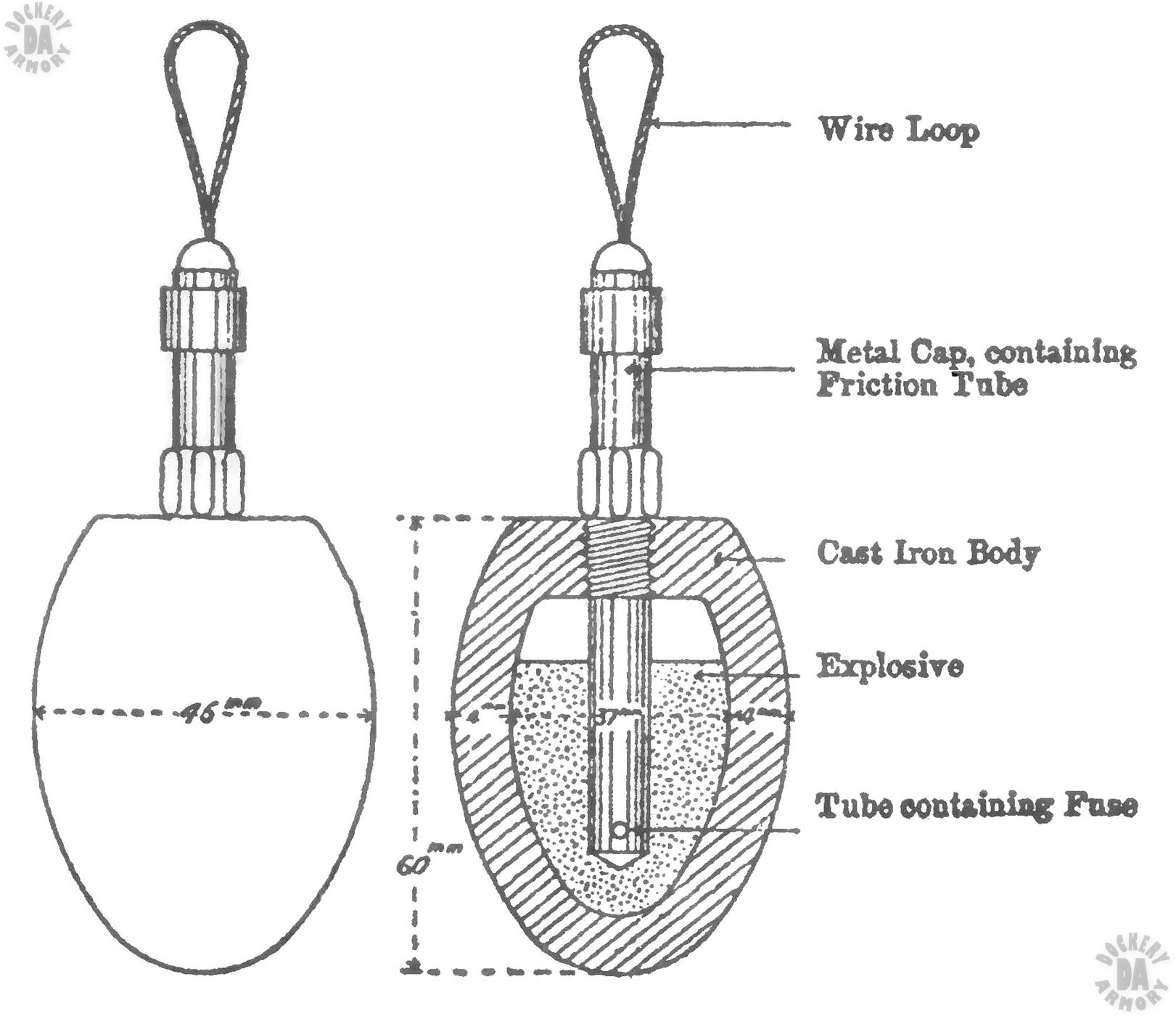
NAME – Model 1915 Egg grenade
NAME (NATIVE) – Eierhandgranate 15
COMMON NAMES – Egg grenade, Pigeon Egg
TYPE – Fragmentation hand grenade
COUNTRY OF ORIGIN – Germany
DATE OF MANUFACTURE – 1916
LENGTH – 6 cm (2.36 in) without fuze, 8.9 cm (3.50 in) with fuze
WIDTH (DIAMETER) – 4.5 cm (1.77 in)
WEIGHT – 0.318 kg (11 oz)
EFFECT – Blast and fragmentation
BURST RADIUS – 8 to 10 m (9 to 11 yards)
FUSE TYPE – Brennzünder 15 pull-type friction igniter
FUSE INITIATION – Sharp pull on wire at top of fuse
FUSE DELAY – 5 seconds
FILLER – Black powder with Barium Nitrate added
FILLER WEIGHT – 0.031 kg (1.11 oz)
FILLER EQUIVALENT TO TNT (R.E.) – 0.56
AVERAGE RANGE – 40 to 50 m (44 to 55 yards)
COLOR CODE – Black body brass or gunmetal fuze, a red band at the top of the fuse indicates a five-second delay
MARKINGS – None on body,
MANUFACTURER – State arsenals
STATUS – Obsolete
SERVICE – Imperial German military
Designed in later 1915, the small grenade began reaching the troops in volume early in 1916 and was still in production with the smooth body in early 1917. The small size of the grenade, about half that of the Kugelhandgranate, allowed a number of them to be carried. Without the large handle of the stick grenades, the Eierhandgranate 15 could be carried in numbers in bread bags, empty sandbags, or even a few in a pocket, though this was not considered a safe practice. The thick iron walls of the Eierhandgranate 15 gave fairly good fragmentation so it was considered an effective weapon. One drawback with the fuse system was that the wire loop could get caught if the carrier wasn’t paying attention. A caught wire when the soldier moved could cause an accidental ignition and subsequent detonation of the grenade. This type of accident caused soldiers issued with the grenade to have a certain level of nervousness when using it. This reluctance to use the weapon could be resolved with more training with the Eierhandgranate 15, and the problem with the fuse was quickly addressed by the designers back in Germany
Though small, the M1915 Egg Grenade proved influential among its enemies. British soldiers facing the handy little explosive device were impressed that the grenade could be thrown nearly 15 meters (over 16 yards) further than the average Brit could throw a No 5 Mills bomb. In December, 1916, British command directed that a small grenade like the M1915 Egg Grenade be developed for the British forces. The small No 34 grenade was produced beginning in January 1916.