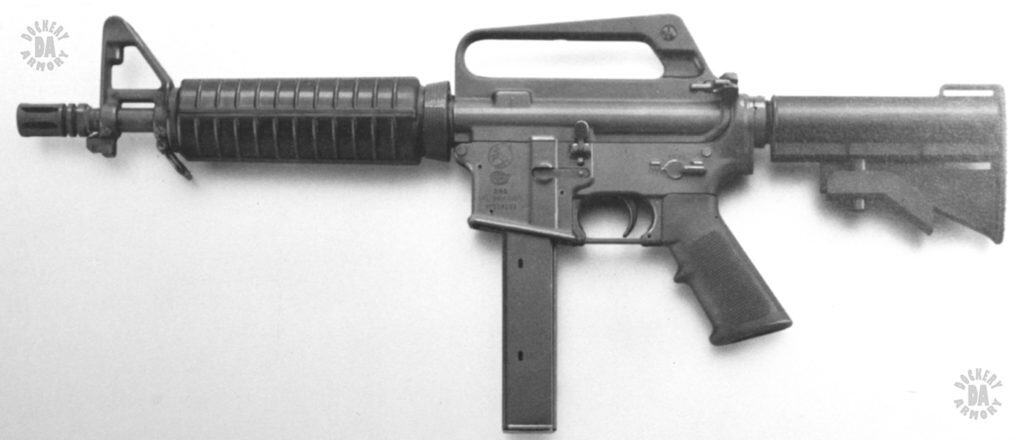
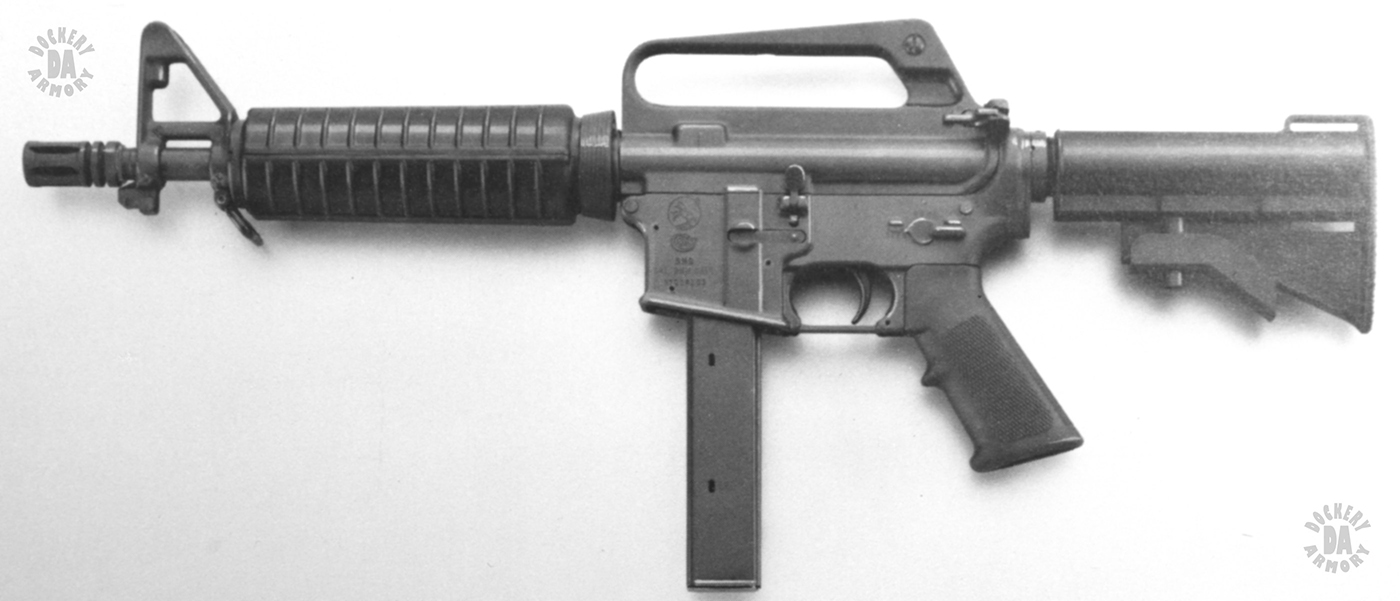
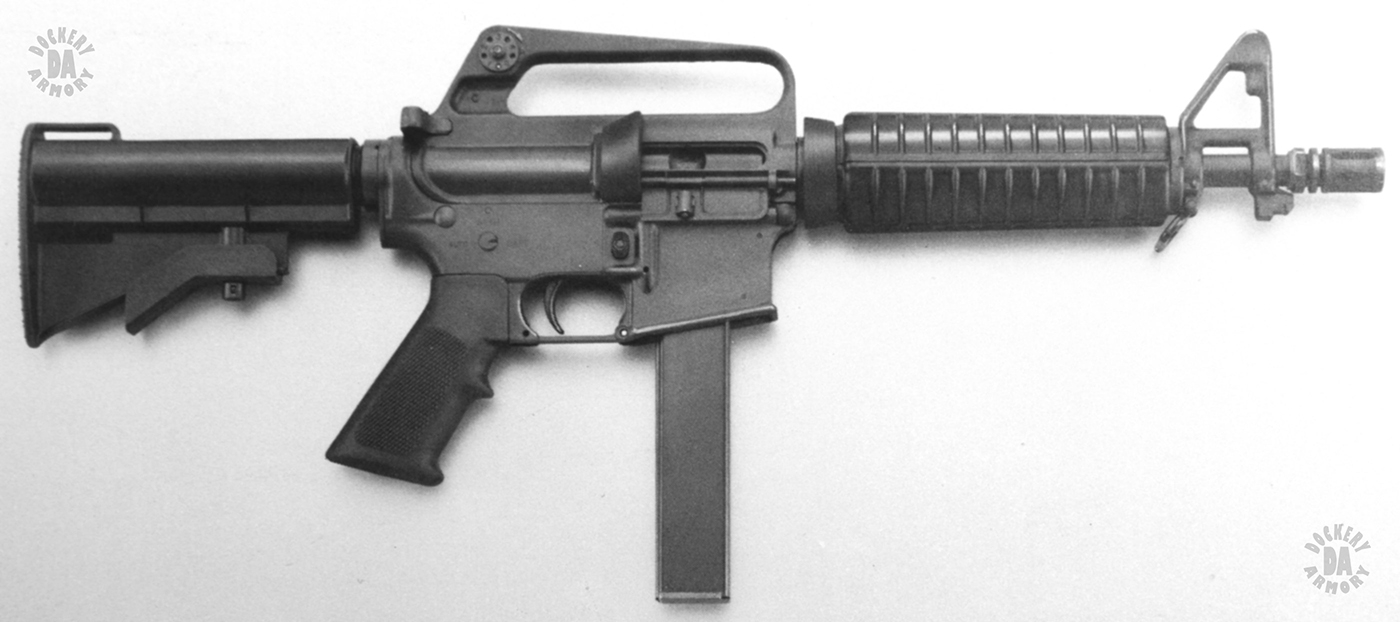
NAME – Colt Model 635
COMMON NAMES – Colt 9mm Submachine gun
COUNTRY OF ORIGIN – USA
DATE OF MANUFACTURE – 1983
CALIBER – 9x19mm NATO
OVERALL LENGTH – 65 cm (25.63 in) Stock collapsed, 73 cm (28.88 in) Stock extended
BARREL LENGTH – 26 cm (10.5 in)
RIFLING (TYPE & TWIST) – Six groove, Right hand twist, 1 turn in 25.4 cm (10 in)
BULLET DIAMETER – 9.02 mm (.355 in)
BULLET WEIGHT – 7.45 g (115 gr)
MUZZLE VELOCITY – 396 m/s (1300 fps)
MUZZLE ENERGY – 584 j (431 ft/lbs)
WEIGHT (EMPTY) – 2.59 kg (5 lbs 12 oz)
WEIGHT (LOADED) – 3.189 kg (7 lbs 1.1 oz) with 32 rounds
SIGHTS – Front, Post, adjustable for elevation, Rear – flip-type apertures, adjustable for windage, short range 0-50 m (0 -55 yds), and long range 50-100 m (55 – 109 yds)
EFFECTIVE RANGE – 100 m (109 yds)
OPERATION – Blowback, fires from closed bolt
TYPE OF FIRE – Selective, semi and full auto (Model RO635)
Selective, Semi and three-round controlled burst (Model RO639)
Semiautomatic only (Model AR6451)
RATE OF FIRE – 50 rpm Semi, 128 rpm Full (Model RO635)
50 rpm Semi, 96 rpm (three-round burst (Model RO639)
50 rpm Semi, (ModelAR6451)
CYCLIC ROF – 800-1000 rpm
FEED DEVICE – 20 or 32 round box magazine, double column, double feed
FEED DEVICE WEIGHT (EMPTY) – 20 round – 0.191 kg (6.75 oz), 32 round – 0.227 kg (8 oz)
FEED DEVICE WEIGHT (LOADED) – 20 round – 0.417 kg (14.7 oz), 32 round – 0.599 kg (1 lb 5.1 oz)
BASIC LOAD – 6 – 32 round magazines (192 rounds)
LOAD WT – 3.594 kg (7 lbs 14.6 oz)
MANUFACTURER – Colt’s Manufacturing Company, Hartford, Connecticut
STATUS – Out of production
SERVICE – Commercial sales, some Military and Law Enforcement
By the early 1980’s, the submachinegun market, particularly for law enforcement within the US, was dominated by the German Heckler & Koch MP5 series. To address this market, Colt developed their own 9mm submachinegun. Since many members of US law enforcement were military veterans already well familiar with the M16 series of rifles, this was the Colt starting point. The use of the 9mm round was predicated for its lack of overpenetration when fired in close quarters such as inside buildings, houses, ships, airfields, and nuclear facilities.
By making the design a straightforward blowback weapon, the entire gas system of the M16 was removed. The bolt and carrier design was made in one piece with no locking lugs. The mass of the bolt carrier mechanism along with the recoil spring and buffer system, was sufficient to allow the bullet to have left the barrel before the cartridge case had been extracted. This allowed the gas pressure in the barrel to have dropped to safe levels before the breech opened. The basic hammer fired mechanism of the M16 design allowed the 9mm version to fire from closed bolt, greatly increasing first round accuracy.
The resulting weapon was a very lightweight and compact variation of the M16 series. The design took a number of aspects of the earlier Colt XM177 and Commando weapons. These aspects include the sliding stock that can be locked in the forward position, making for an even more compact package. The raised sight line and in-line recoil of the barrel being centered with the buttstock cut back on muzzle climb when the weapon is fired on full automatic.
Soon after release of the Colt 9mm submachinegun a large cartridge case deflector and shield was added to the back half of the ejection port. This shield helped keep gas and unburned powder particles from being blown back into the operators face when the weapon was fired. Additionally, a hydraulic buffer was designed for the Colt 9mm. The hydraulic buffer, listed as HB in the weapons model designation, helps lower the cyclic rate of the 9mm by 100 to 200 rounds per minute. That lower rate of fire adds to the accuracy of the weapon on full automatic fire as well as giving the operator additional control of the system.
The Colt 9mm basic series included three different models;
Model 634 – Capable of semiautomatic fire only.
Model 635 – Capable of semi and full automatic fire.
Model 639 – Capable of semiautomatic fire and mechanically controlled three-round bursts.
Other that the fire control settings, these models are identical in physical characteristics.