CODE – 02-113-011
NAME – B&T APC9K
COMMON NAMES – Sub Compact Weapon (US Army)
COUNTRY OF ORIGIN – Switzerland
DATE OF MANUFACTURE – 2011
CALIBER – 9x19mm
OVERALL LENGTH – 37.8 cm (14.88 in) Stock folded, 59.7 cm (23.5 in) Stock extended
OVERALL LENGTHWITH SUPPRESSOR MOUNTED – 45.4 cm (17.87 in) Stock folded, 67.3 cm (26.5 in) Stock extended
BARREL LENGTH – 17.5 cm (6.89 in)
SUPPRESSOR LENGTH – 10.9 cm (4.29 in)
SUPPRESSOR DIAMETER – 4 cm (1.57 in)
RIFLING (TYPE & TWIST) – 1 turn in 25.4 cm (10 in)
BULLET DIAMETER – 9.03 mm (0.355 in)
BULLET WEIGHT – 7.26 g (112 gr) M882 Ball
MUZZLE VELOCITY – 385 m/s (1263 fps)
MUZZLE ENERGY – 538 j (397 ft/lb)
WEIGHT (EMPTY) – 2.45 kg (5 lb 6 oz)
FRONT GRIP WEIGHT – 0.90 kg (3.2 oz)
WEIGHT (LOADED) – 1.33 kg (2 lb 14.9 oz) with 30 rounds
WEIGHT (LOADED) – 2.314 kg (5 lb 1.6 oz) with Aimpoint Micro TL sight, Front grip, 30 rounds
WEIGHT (LOADED) WITH SUPPRESSOR – 2.70 kg (5 lb 15 oz) with Aimpoint sight, front grip, 30 rounds, Suppressor
SUPPRESSOR WEIGHT – .388 kg (13.7 oz)
SUPPRESSOR MOUNTING – 3-lug quick mount and thread
SUPPRESSOR OPERATION – Expansion chamber with multiple baffle stack
SUPPRESSOR DECIBLE REDUCTION – 14 db down from 159 db
SIGHTS – Integral top-mounted Picatinny rail, Aimpoint Micro TL, Emergency flip-up iron sights, Front-Blade, Rear peep
SIGHT WEIGHT – 0.084 kg
EFFECTIVE RANGE – 50 m (55 yds)
OPERATION – Blowback, fires from closed bolt
TYPE OF FIRE – Select fire, semi and full automatic
RATE OF FIRE – 40 rpm Semi, 90 rpm Full
CYCLIC ROF – 1080 rpm
FEED DEVICE – 15 & 30 round translucent polymer magazines, double column, double feed
FEED DEVICE WEIGHT (EMPTY) – 15-round – 0.062 kg (2.2 oz), 30-round – 0.081 kg (2.9 oz)
FEED DEVICE WEIGHT (LOADED) – 15-round – 0.24 kg (8.5 oz), 30-round – 0.43 kg (15.2 oz)
BASIC LOAD – 1-15 round magazine, 2 – 30 round magazines (75 rounds)
LOAD WT – 1.1 kg (2 lb 6.8 oz)
MANUFACTURER – B&T, Thun, Switzerland
STATUS – In Production
SERVICE – Austrian EKO Cobra Counterterrorism unit, US Military Personal Security Details
The B&T Company was established in Switzerland in 1991 by Karl Brügger and Heinrich Thomet. Originally, they were a manufacturer of firearms parts and accessories but have expanded into manufacturing complete firearms in the last decade. The B&T Company is known for their precision and craftsmanship when it comes to any of their products. That reputation extends into their firearms and has resulted in one of their weapons having been adopted by the US Army as a new compact submachinegun for personal security details.
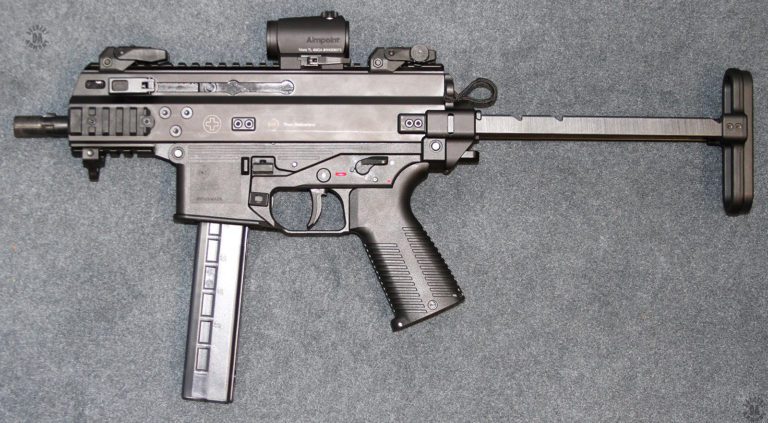
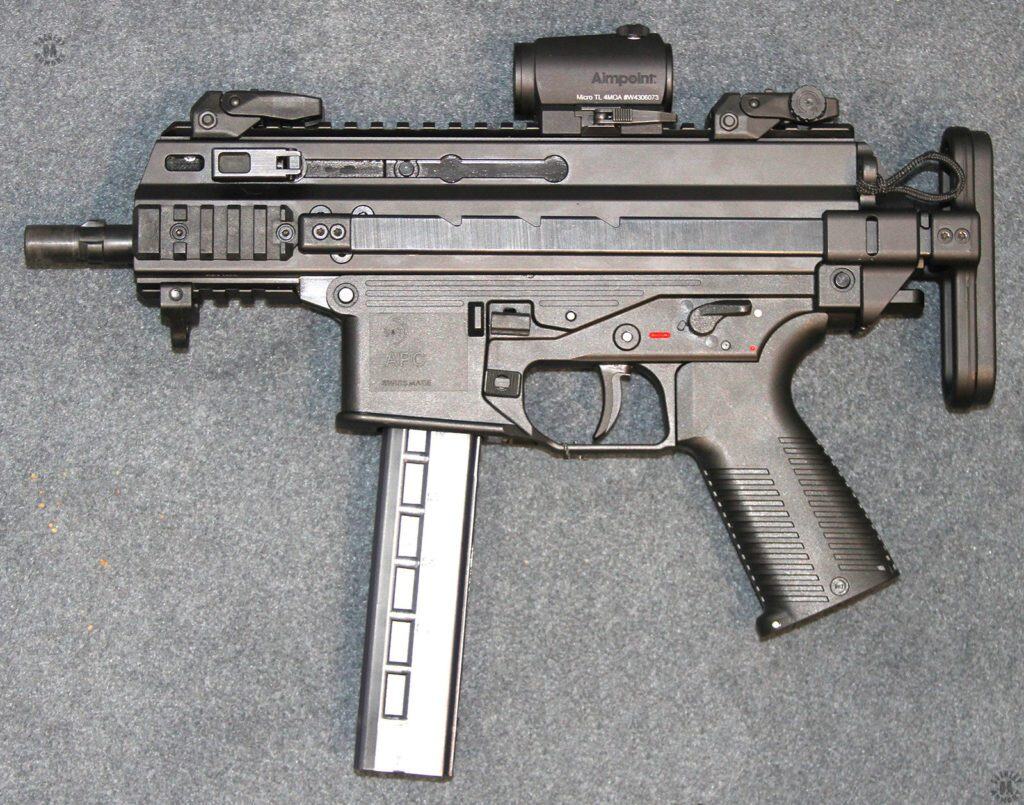
Designed to meet a request from the Austrian EKO Counterterrorism unit, the APC9K (Automatic Police Carbine, 9mm, Kurtz [short]) is a straight blowback design hammer fired from a closed bolt for maximum first-round accuracy. All aspects of the weapon are of maximum precision combined with ultra-modern manufacturing techniques. The receiver is an aluminum extrusion for strength with minimum weight. A number of the other components are made of specialized plastic materials for both weight and strength as well as minimizing corrosion. The finish of the machining of internal and external components are of a very high quality, feeling and appearing much like a fine commercial firearm rather than a military weapon. The bolt is manufactured through traditional machining methods but has been laser-hardened. This system gives the surface of the bolt maximum precise hardness for wear and strength.
To increase the controllability when firing the APC9K, particularly on full automatic, the weapon has a hydraulic buffer and the rear of the receiver to minimize the impact of the bolt and hold down the felt recoil. This hydraulic buffer also allows for a lighter recoil spring, holding down the force needed to operate the action. To cock the weapon, there is a fully ambidextrous set of folding cocking handles, one on each side of the weapon. The cocking handles do not reciprocate with the bolt as the weapon is fired. The safety/selector switch is also made fully ambidextrous, with the control duplicated on both sides of the weapon.
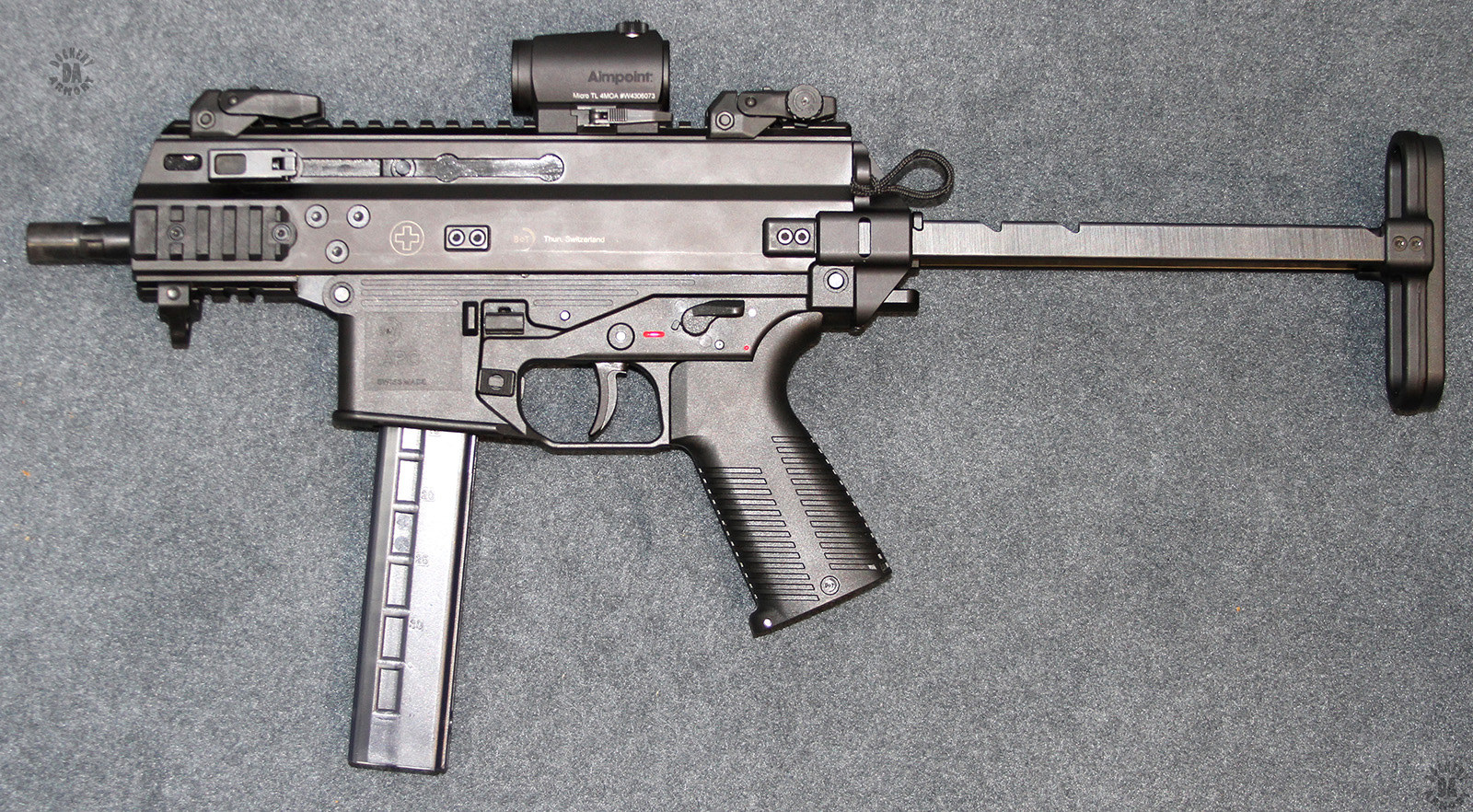
There are folding iron sights on the top of the weapon, inletted into the front and back of the full-length Picatinny rail. Alternate folding sights are available that extend up above the rail when mounted. The folding sights are intended for emergency use as the weapon is intended for use with a single-point sight, normally the Aimpoint Micro TL. There are additional lengths of Picatinny rail along both sides and the bottom of the front grip for attachments of aiming or illumination devices as well as a vertical front grip. The muzzle of the weapon has a 3-lug adapter for the attachment of a suppressor. For acceptance by the US, a compact suppressor was chosen for maximum concealability while holding down muzzle flash from the short barrel. Magazines are translucent plastic to allow for the remaining rounds to be easily seen by the operator. To minimize damage to the magazine when dropped, such as for a combat reload, there is a removable rubber boot that can be placed on the bottom of the mag.
The trigger pull is crisp and clean, to meet with the precision of the rest of the weapon. Generally, the APC9K is considered one of the most accurate submachineguns on the world market today.
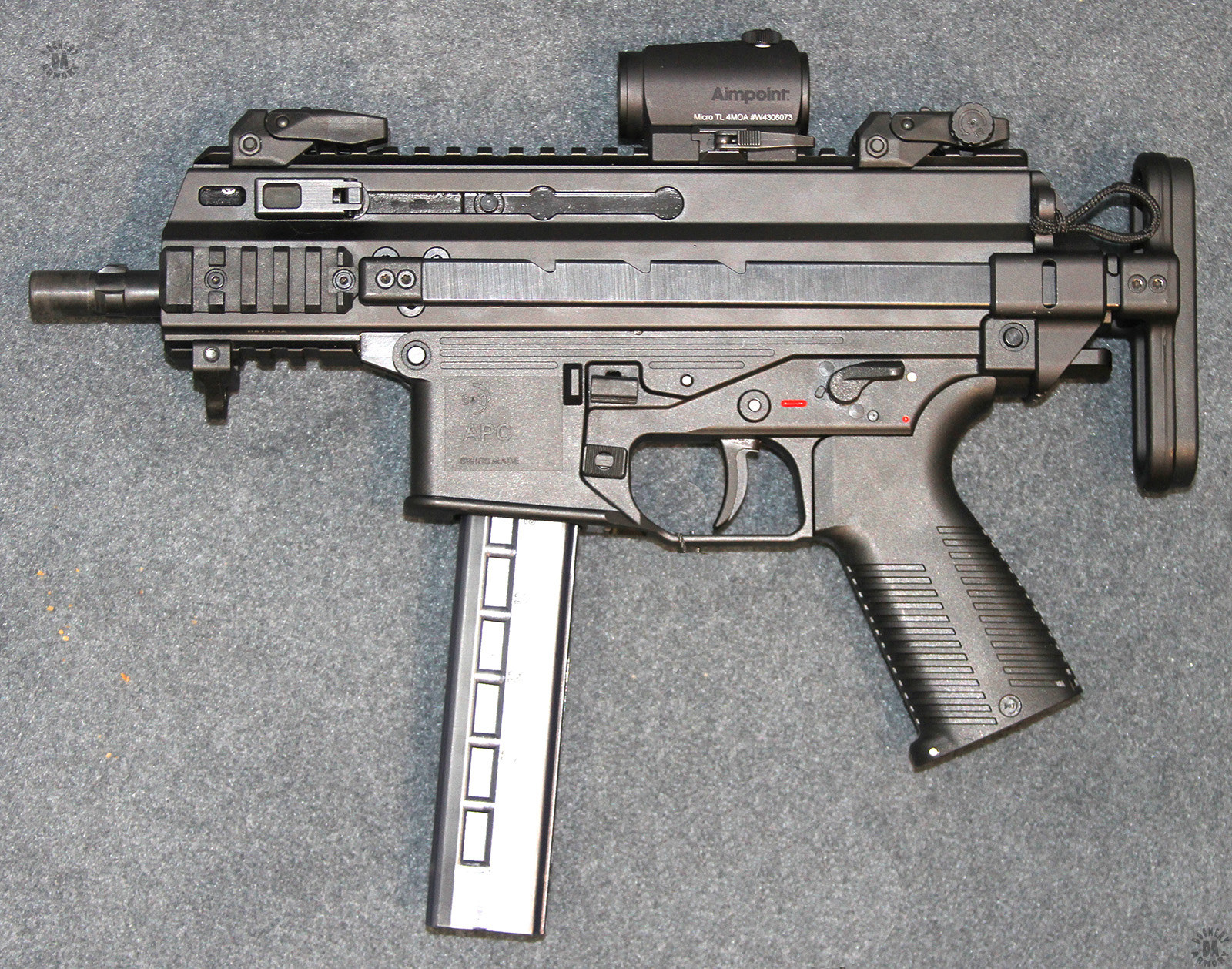

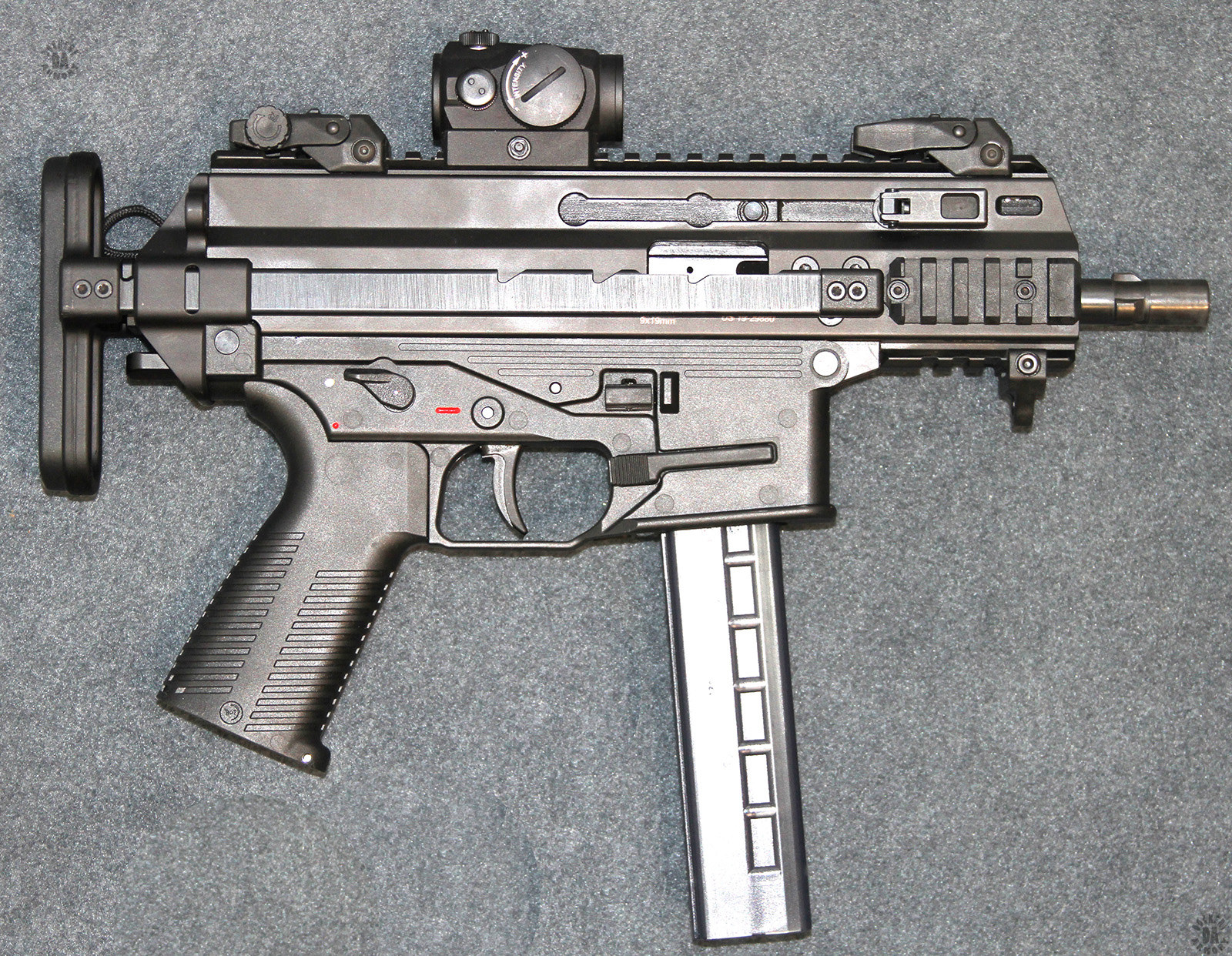
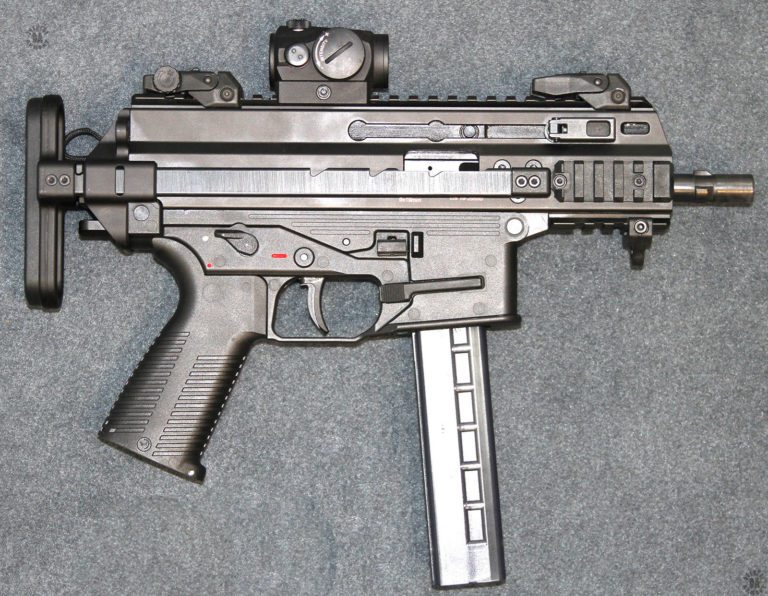
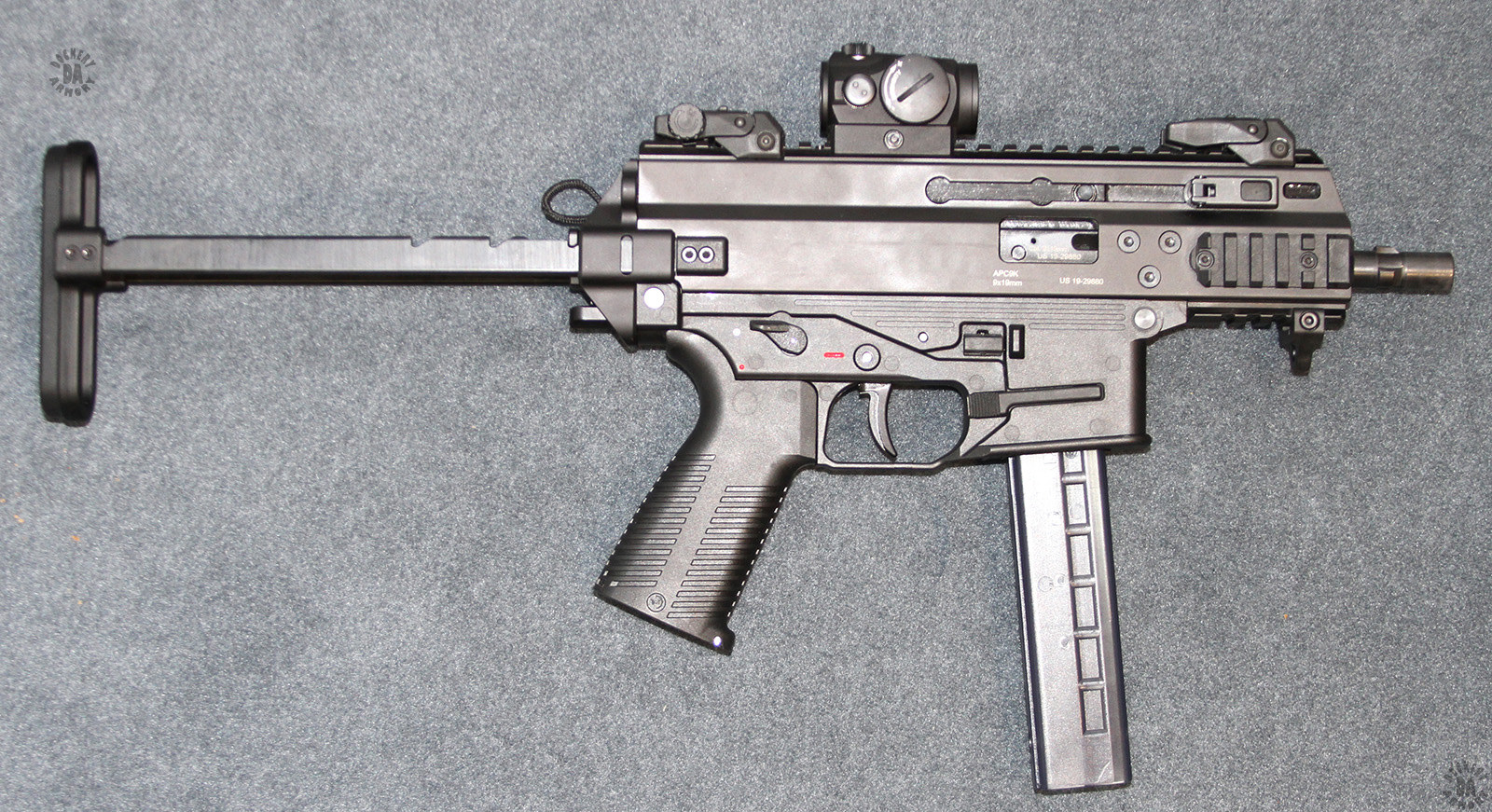
At the top forward portion of the receiver is the cocking lever, folded in at the front of the cocking slot. The lever automatically returns to the forward position after the weapon is cocked and remains forward position as the weapon is fired. The long, rectangular bar along the center of the receiver is the telescopic stock strut. The three notches on the stock strut are the locking points for the different lengths of stock as preferred by the operator. The stock itself is not locked but can be extended by a simple pull on the butt. The locking notches are angled so that the stock can be extended further when locked in an intermediary position by another pull of the butt. The weapon is loaded with an empty B&T 30-round magazine that does not have the optional rubber bumper base.
The rectangular button directly in front of the trigger guard is the left-side magazine release. Above the magazine catch is the bolt release control that is automatically engaged when the last round is fired, locking the bolt to the rear. Above and behind the trigger is the left-side safety/selector lever. The lever is pushed up to the white dot on this specimen, indicating that the weapon is on safe. Pressing the lever down to the single red dot sets the weapon on semiautomatic fire. Pushing the selector lever forward to the red bar sets the weapon on full automatic fire. The small loop of line at the rear of the receiver is the rear sling swivel point. PHOTO CREDIT: KEVIN DOCKERY