CODE – 02-132-952

NAME – M3 90 degree Barrel Mount

COMMON NAMES – M3 Krummlauf

COUNTRY OF ORIGIN – USA

DATE OF MANUFACTURE – 1952

CALIBER – 11.43x23mm (.45 ACP)

OVERALL LENGTH – 57.9 cm (22.8 in) Stock closed, 75.7 cm (29.8 in) Stock extended

OVERALL LENGTH WITH BARREL MOUNTED – 104.8 cm (41.25 in) Stock closed

BARREL LENGTH – 20.3 cm (8 in)

CURVED BARREL LENGTH – 62.6 cm (24.63 in)

RIFLING (TYPE & TWIST) – Curved Barrel – Smoothbore

BULLET DIAMETER – 11.46 mm (0.451 in)

BULLET WEIGHT – 15 g (230 gr)

WEIGHT (EMPTY) – 3.63 kg (8 lb)

CURVED BARREL WEIGHT – 4.14 kg (9 lbs 2 oz)

WEIGHT (EMPTY) 7.77 kg (17 lb 2 oz) with barrel mounted

WEIGHT (LOADED) – 8.78 kg (19 lbs 5.6 oz) with barrel mounted and 30 round magazine

SIGHTS – None with curved barrel

EFFECTIVE RANGE – 18 m (20 yds)

OPERATION – Blowback, fires from open bolt

TYPE OF FIRE – Full automatic

RATE OF FIRE – 90 rpm

CYCLIC ROF – 450 rpm

FEED DEVICE – 30 round box magazine, Double column, Single feed

FEED DEVICE WEIGHT (EMPTY) – 0.37 (13 oz)

FEED DEVICE WEIGHT (LOADED) – 1.01 kg (2 lbs 3.6 oz)

BASIC LOAD – 6 magazines (180 rounds)

LOAD WT – 6.06 kg (13 lbs 5.8 oz)

STATUS – Obsolete

SERVICE – Field tests only

     The German Krummlauf, or curved barrel, was an experimental attachment for the early assault rifles (MP43, MP 44) to be able to shoot around corners without exposing the firer. Though the idea was tried out for city fighting, being able to shoot somewhat accurately around the corner of a building, that was not its most successful application. That application was to mount a curved barrel on a movable mount on tanks in order to fire down on attacking troops close-in to the tank. The idea had a great deal of merit for defense of armored vehicles and was examined by the US military after World War II.

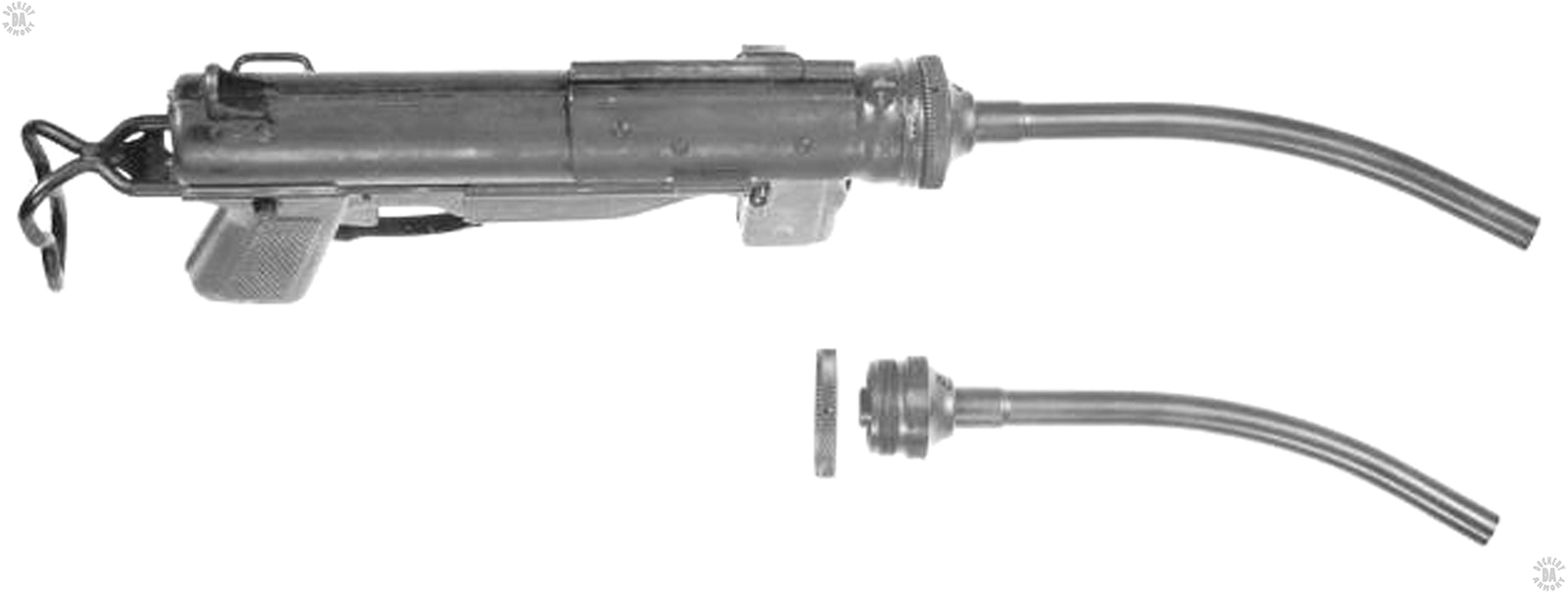
     There were some simple bent barrels made for the M3A1 submachinegun. These were just a longer barrel with a 30 degree curve bent into the barrel. The project was considered for city fighting, but never went beyond experimental stages. For the defense of tanks, the idea was considerably more developed.

     The most developed of the curved barrels was the periscope-mounted version. The barrel of the submachinegun would be inserted into the base of the curved barrel and locked in place with a large collet nut. This curved barrel was one of the longest of this type produced. Instead of being an actual barrel, the curved front half of the device was a trough with the inside part of the curve open to the air. The fired projectiles would hit the very thick metal of the curved portion of the barrel and be forced to move 90 degrees to the normal direction of travel. The projectiles would be deformed from their travel through the curve, and would occasionally break up. But for close in defense of a tank, they were sufficiently lethal for their purpose.

     One mount used in the M4 Sherman was in the turret top. In place of the standard M6 periscope on the upper left side of the turret top was the T20, a model that could accept the curved greasegun barrel along the side of the periscope body. The barrel could be rotated 360 degrees as well as elevated or lowered 40 degrees. This allows the M3 submachinegun inserted into the curved barrel to sweep the sides and decks of the tank.
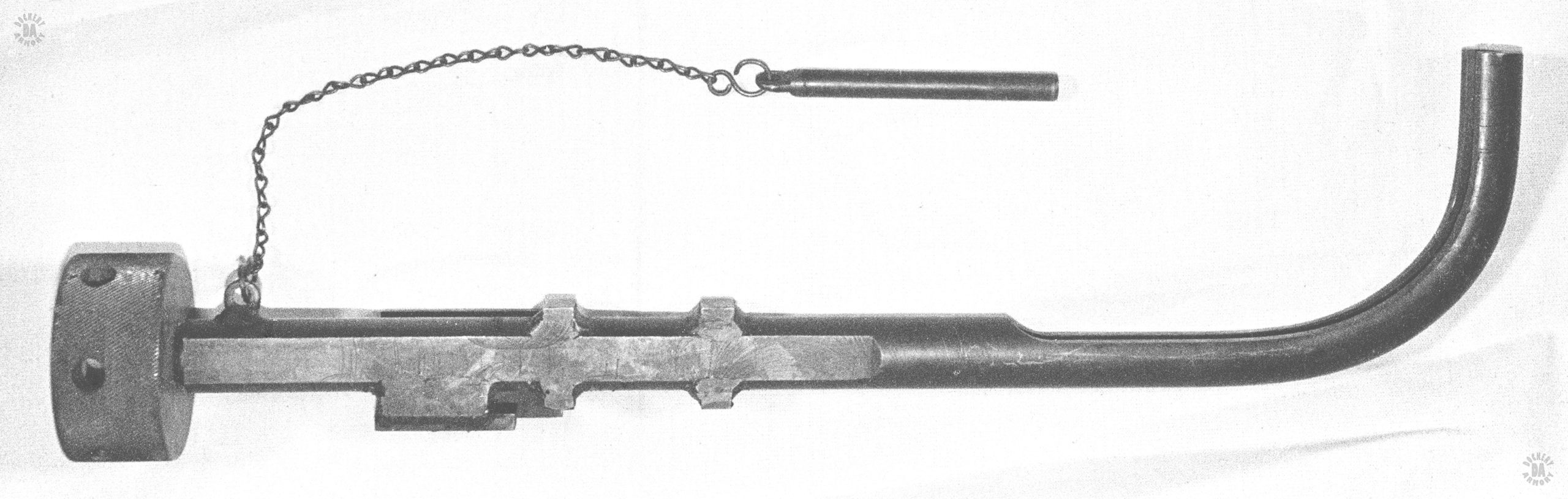
 

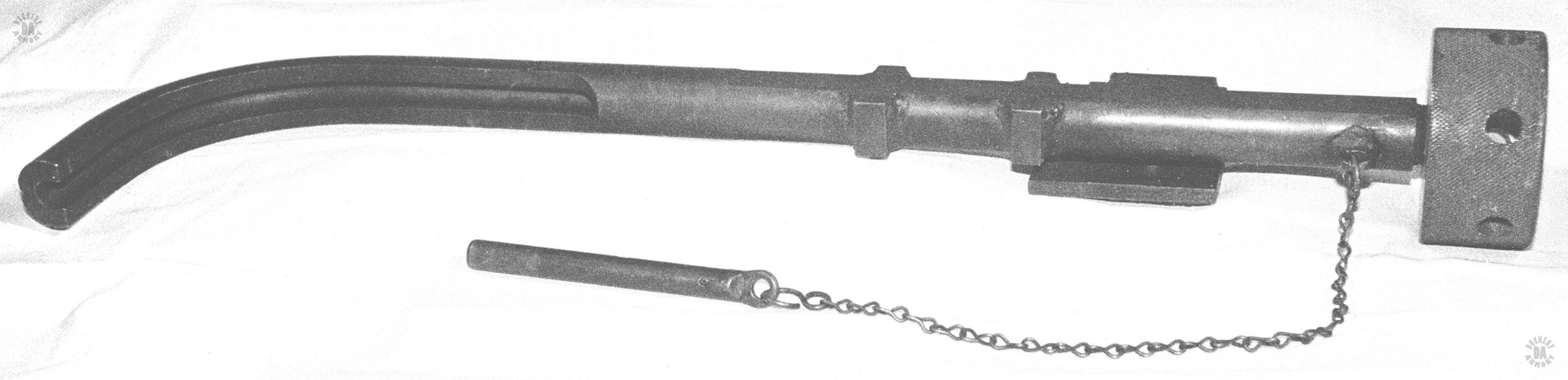
One of the curved barrel experiments produced after World War II. This is the 90-degree bent barrel attachment for the M3 and M3A1 submachinegun. The curved end of the barrel is not solid but more a curved trough to guide the bullets around a corner. The collet at the base of the attachment is for securing the barrel of an M3 or M3A1 submachinegun in place. The barrel of the weapon would be fully inserted into the attachment and the collet turned tight with the wrench rod attached to the small chain. The attachment was intended to be used for close-in defense of a tank. The flat portion near the base of the device along with the heavy lugs is to secure the curved barrel to a T20 periscope used in a tank turret. PHOTO CREDIT: Kevin Dockery

A side view of the 90-degree curved barrel attachment developed by the US Army following World War II. The curved portion of the device can be seen to be a trough rather than a barrel. This allows the projectiles to more easily negotiate the sharp curve. In spite of this, bullet fired through the device would deform and sometimes fragment. Given that the expected range of the device when used to defend a buttoned-up tank would be ten to fifteen feet, fragmentation of the bullets was not considered a great drawback. PHOTO CREDIT: Kevin Dockery

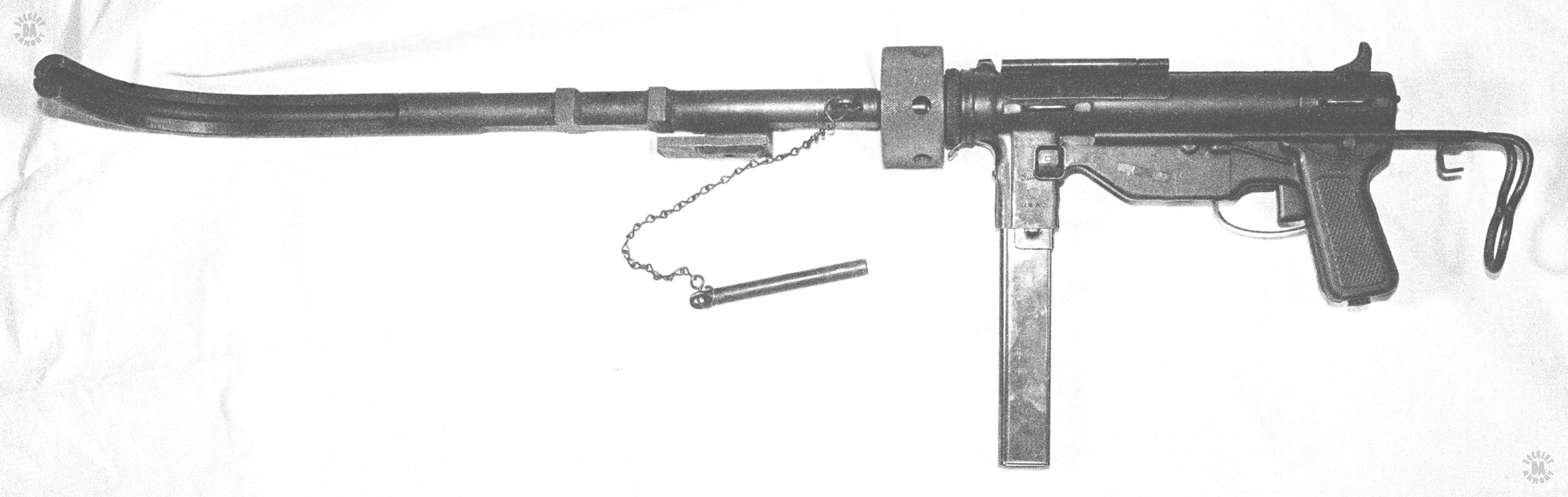
The curved barrel attachment mounted on an M3A1 submachinegun. The collet attachment would allow the weapon to be rotated into the best position for use within the confines of a tank turret. Then the collet could be tightened with the attached wrench rod.  The device, mounted on an M3A1, would be far too heavy for dismounted use. It also becomes very hot when used, for even a single magazine fired through it. PHOTO CREDIT: Kevin Dockery
The curved barrel attachment mounted on an M3A1 submachinegun. The collet attachment would allow the weapon to be rotated into the best position for use within the confines of a tank turret. Then the collet could be tightened with the attached wrench rod. The device, mounted on an M3A1, would be far too heavy for dismounted use. It also becomes very hot when used, for even a single magazine fired through it. PHOTO CREDIT: Kevin Dockery

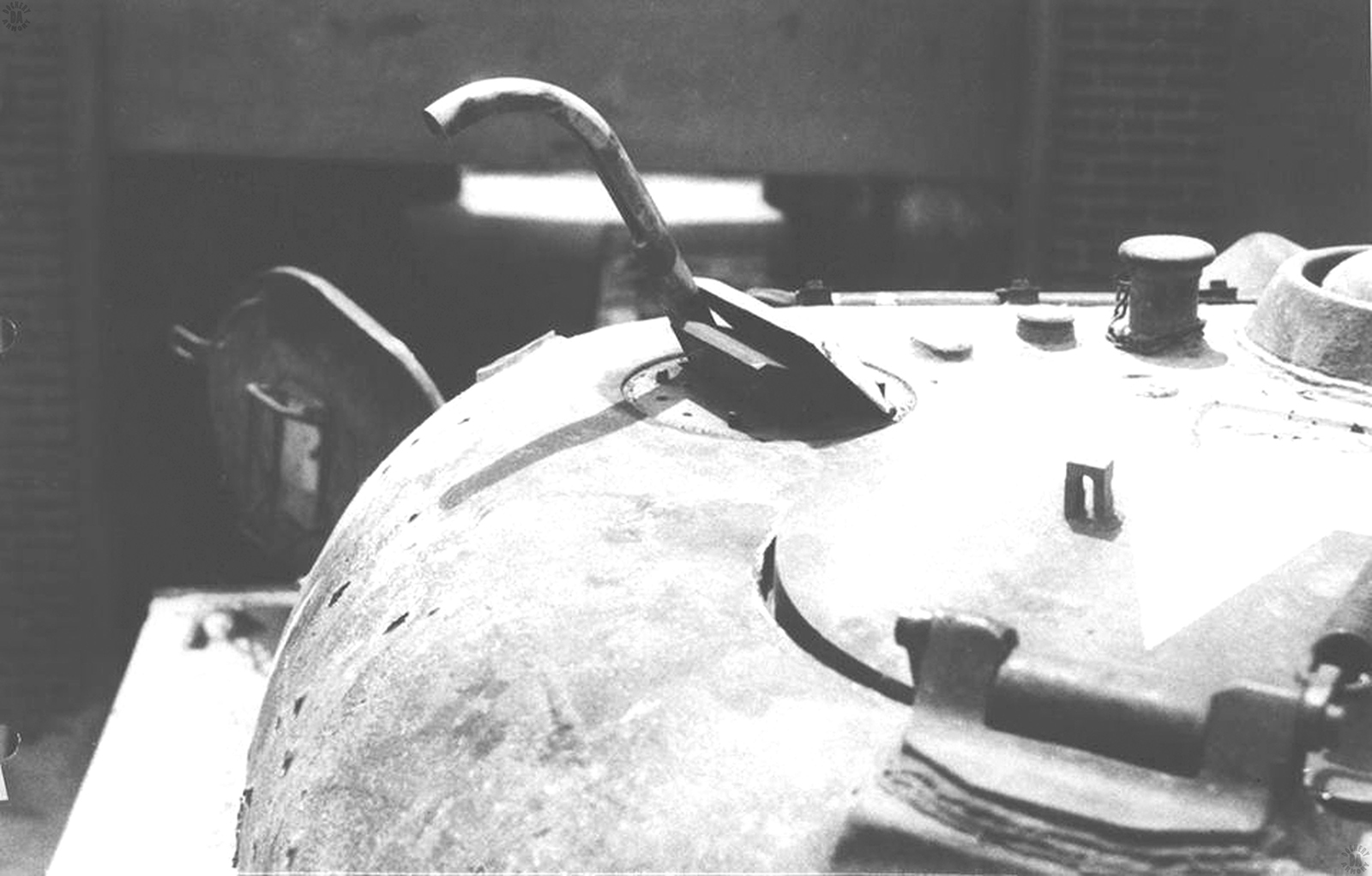
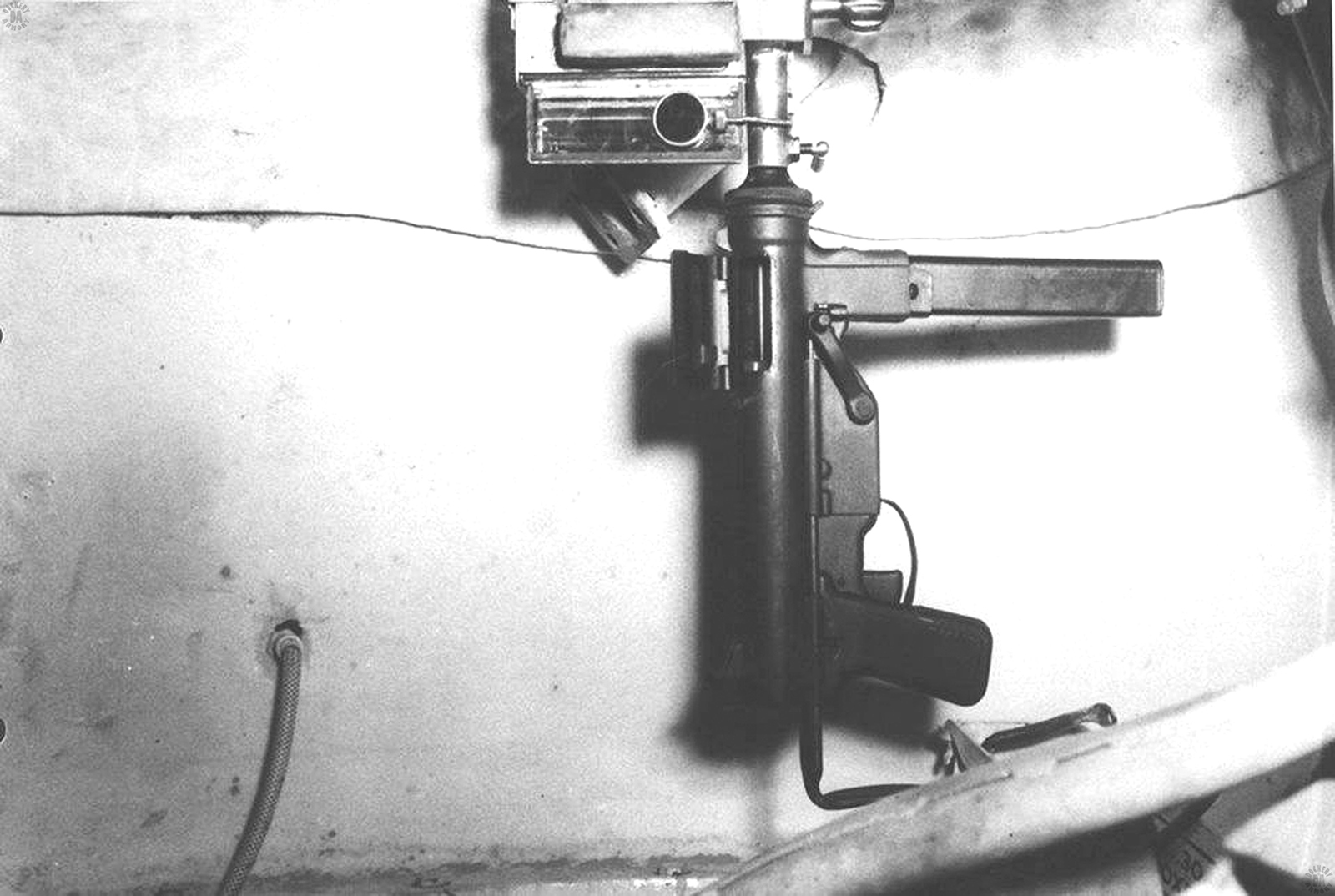
The curved barrel device sticks up next to the periscope in the turret of an M4 Sherman tank. The device can be rotated by turning the periscope as well as being tilted for close or more distant targets. The armor of the tank would have only a slight chance of being damaged by the bullets from the device, in comparison to enemy infantry swarming the tank. Photo Credit:  Friends of the Tank Museum
The curved barrel device sticks up next to the periscope in the turret of an M4 Sherman tank. The device can be rotated by turning the periscope as well as being tilted for close or more distant targets. The armor of the tank would have only a slight chance of being damaged by the bullets from the device, in comparison to enemy infantry swarming the tank. Photo Credit: Friends of the Tank Museum

The M3 curved barrel mounted within the turret of an M4 Sherman tank. The device has an M3 submachinegun inserted and mounted in place. The weapon is cocked and ready to fire. It would be moved and aimed with the T20 optical periscope next to the barrel. PHOTO CREDIT: Friends of the Tank Museum.

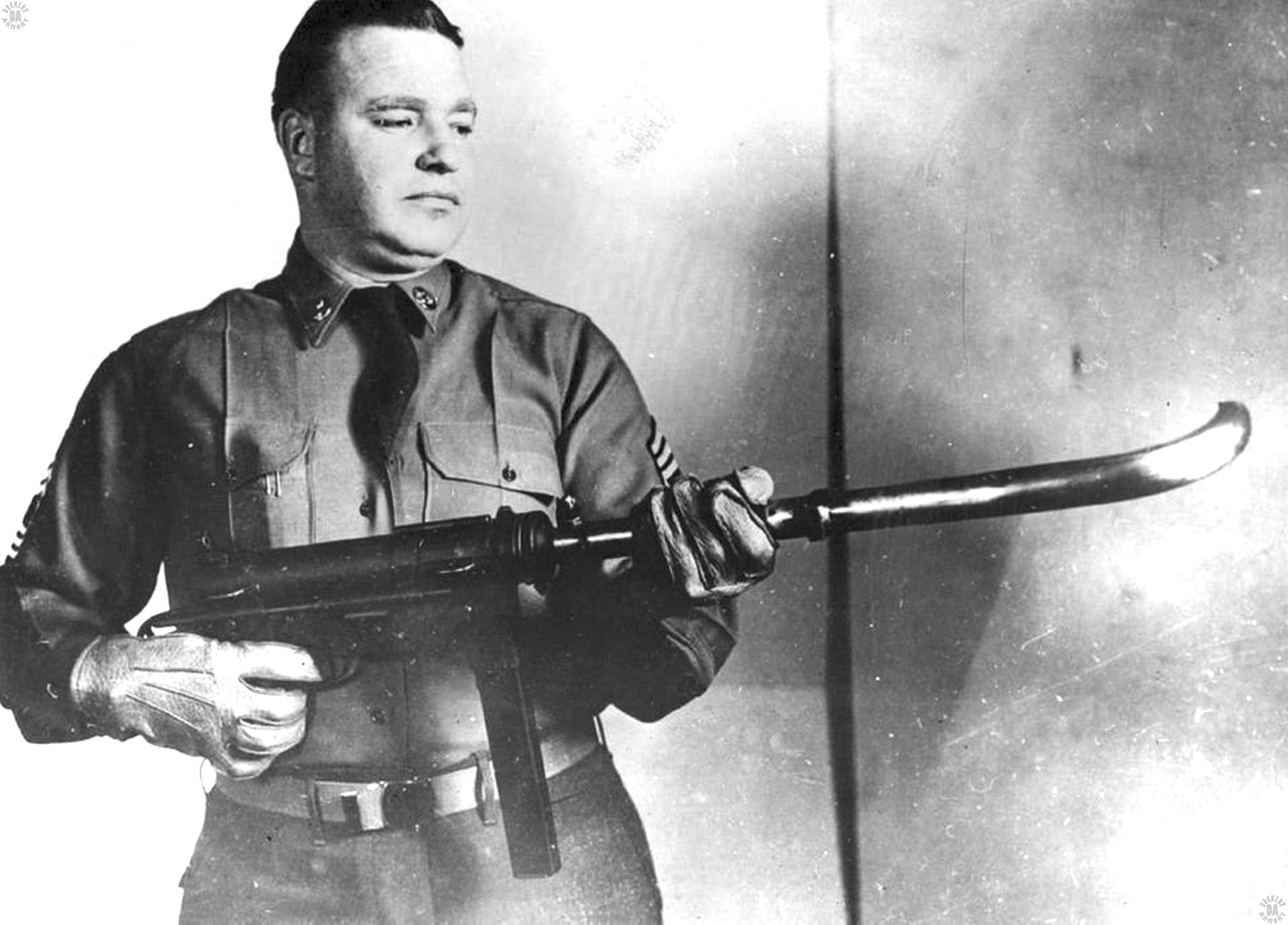
A US Army Master Sergeant holding an M3 submachinegun attached to the 90-degree curved barrel attachment. This photo is circa 1953 during the Korean War. Though the device is not to heavy to hold, the operator is wearing thick leather gloves. These are necessary due to the heat that will be generated in the attachment when it is fired. The heat being a combination of that generated by firing the weapon and the friction of the bullet passing through the curved portion of the barrel. The photo does demonstrate that the curved barrel attachment can be used to shoot around corners without exposing the firer, but it is not a very practical matter. PHOTO CREDIT: US Army

In an attempt to adapt the curved barrel idea to an infantry use, other designs were produced. This is the 30-degree curved barrel attachment designed for the M3 and M3A1 submachineguns from the original German idea during WWII. The device is mounted on an M3A1 in this illustration. The two parts below the weapon are the curved barrel with its threaded collar and a barrel collar locking ring. The barrel would be screwed into the weapon in place of the standard barrel and locked with the collar. The barrel is curved and solid, without having the trough portion as did the 90-degree version. This photograph was taken circa February, 1947. PHOTO CREDIT: US Army